
Fantastic Futures 2026
Trust in the Loop
– subject to change –
February 9, 2026: Call for proposals
March 6, 2026: Full submission instructions and submission portal opens
April 6, 2026: Proposals Due
June 1, 2026: Decisions & notifications to authors
July 6, 2026: Conference Schedule released
September 14, 2026: AI4LAM DC Chapter-hosted events, affiliate meetings, tours
September 15, 2026: AI4LAM Member Day, and FF2026 Workshops and WGs
September 16-17, 2026: 2026 AI4LAM Fantastic Futures: Trust in the Loop
September 18, 2026: AI4LAM DC Chapter-hosted events, affiliate meetings, tours
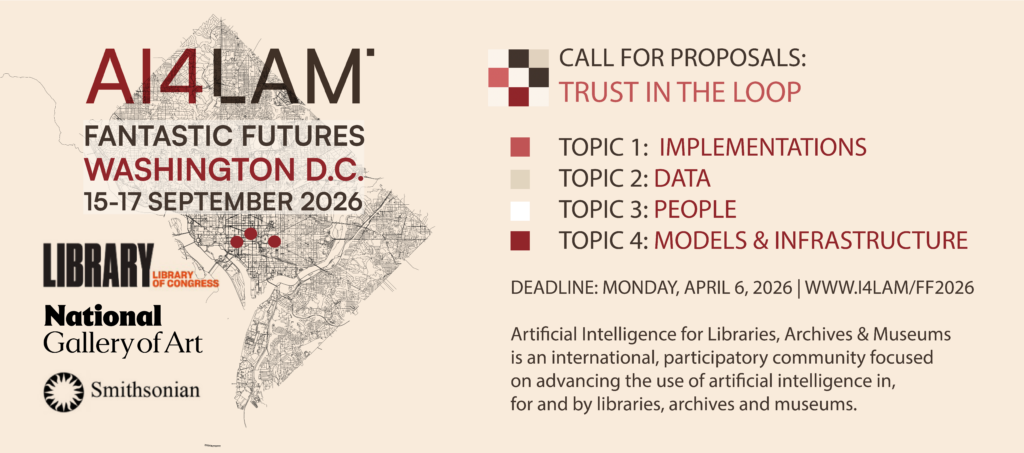
Trust is a cornerstone of libraries, archives, and museums. Trust in the Loop extends the idea of “human in the loop” to focus on the work LAMs must do to ensure that AI-enabled services are built on trust, authenticity, and accountability.
The AI4LAM Fantastic Futures 2026: Trust in the Loop conference is co-hosted by the Library of Congress, the National Gallery of Art, and the Smithsonian Institution, with support from staff at these organizations and the AI4LAM DC Chapter.
The Program Committee is led by the co-hosts, with guidance and input from AI4LAM members, the AI4LAM Board of Directors, and experts from the libraries, archives, and museums (LAM) community.
Submissions for the 2026 AI4LAM Fantastic Futures: Trust in the Loop program are due Monday, April 6, 2026.
Call For Proposals
Topic 1: Implementations
We invite the AI4LAM community to share how AI tools and systems are being implemented in libraries, archives, and museums.
LAMs work within real constraints, including limited resources, legacy systems, complex data, and responsibilities to staff, users, and communities. Proposals should explore how organizations are making progress with AI while supporting ethical and responsible practices.
Strong proposals would address some of these relevant questions:
- What principles, frameworks, or governance structures guide AI investment and decision-making?
- What goals are driving AI implementation?
- How are risks identified and mitigated?
- How is success or impact measured?
- What challenges arise when scaling pilots into operational systems?
- What long-term benefits and costs are anticipated?
- What AI implementations are being pursued, reconsidered, or deliberately avoided?
Topic 2: Data
AI systems are data-driven, and responsible AI implementation depends on the quality, structure, and context of data.
LAMs steward vast amounts of unique and culturally significant data. However, this data is often messy, incomplete, multilingual, historically situated, or poorly represented in foundation models.
Proposals may address:
- Risks and benefits of using LAM data in AI systems
- Data preparation, documentation, and standards for AI use
- Reviewing and validating the quality of AI outputs
- Effective data structures and preparation methods
- Use of controlled vocabularies in AI workflows
- Shared performance benchmark datasets for LAM content and tasks
- Implementation of MCP or other approaches to manage external use of data
- Strategies to manage data scraping or approaches to navigate relationships with commercial AI companies
- Emerging policies, procedures, and governance practices for AI data use
Topic 3: People
AI adoption affects users, visitors, patrons, staff, and communities.
With widespread access to AI tools, audiences expect new services, and staff are exploring how AI fits into their work. Proposals should focus on how organizations support people both inside and outside the AI loop.
Questions to consider:
- How are AI tools used to engage users in new ways?
- What training or capacity-building programs exist for staff or users?
- How is staff expertise integrated into AI workflows?
- How are AI outputs reviewed for quality and appropriateness?
- How do staff experience and respond to evaluating AI outputs?
- How are communities and stakeholders engaged when LAM content becomes AI training data?
- How are expectations managed with vendors, leadership, boards, or oversight bodies?
Topic 4: Models & Infrastructure
LAMs have a long tradition of collaboration around professional practices, open tools, and shared infrastructure. AI presents new opportunities—and challenges—for collective work.
Relevant topics include:
- Shared infrastructure needs for AI in LAMs
- Long-term data storage, security, and transfer requirements
- Approaches for sharing data, models, and documentation across institutions
- Evaluating AI tools and models for LAM use
- Reporting incidents or issues related to AI operations in LAMs
- Estimating and managing long-term costs and resource use
Coming soon:
AI4LAM Futures Challenge Announcement and Innovation Awards