3D and Image Analysis Working Group
Focuses on two complementary domains – the acquisition and creation of 3D models and the application of artificial intelligence for analysing 3D models and image (pictorial) data. The group aims to bridge data generation and advanced AI-based interpretation.
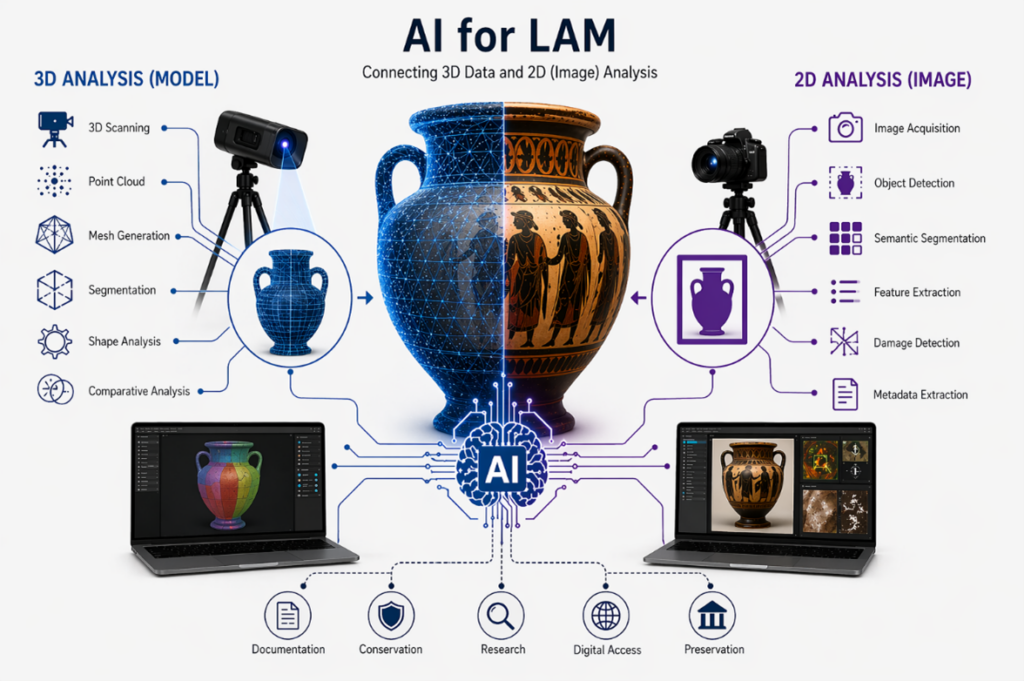
The Working Group is structured around two main fields: 3D Data Acquisition and Model Creation, and AI-based Analysis of 3D Models and Image Data.
Field A – 3D Data Acquisition and Model Creation
3D Data Acquisition and Model Creation is generated, captured, and prepared for further use, covering both established and experimental techniques. This includes methods such as 3D scanning (e.g., structured light and laser scanners) that produce point clouds and meshes, and photogrammetry, which uses multiple images to reconstruct 3D geometry. Volumetric approaches such as CT and MRI enable reconstruction of internal and external structures, supporting non-destructive analysis. In addition, 3D models can be created using CAD and parametric design tools, which are increasingly supported by AI-assisted workflows. Emerging approaches include AI-based 3D generation, such as text-to-3D and image-to-3D methods, as well as automated mesh refinement and texture generation. The goal is to better understand and optimize workflows for producing high-quality, reusable 3D models, particularly in cultural heritage contexts.
Field B – AI-based Analysis of 3D Models and Image Data
AI-based Analysis of 3D Models and Image Datafocuses on how artificial intelligence can be applied to interpret both 3D and 2D data, again combining established and emerging methods. For 3D data, this includes geometry and shape analysis, segmentation of objects into meaningful parts, detection of structural features or defects, and comparison between different states (e.g. historical versus restored elements). For 2D image data, AI enables tasks such as image classification, object detection, semantic segmentation, and surface inspection. These analyses rely on a range of AI techniques, including convolutional neural networks and vision transformers for images, as well as 3D neural networks, point cloud models, and neural rendering approaches such as NeRF for 3D data. Newer methods such as vision and language models (VLM), 3D IIIF protocol, diffusion models and transformer-based systems etc. are expanding possibilities in both analysis and generation.
The overall aim is to explore how both established and experimental AI approaches can support new ways of understanding, analyzing, and enriching cultural heritage data, bridging the gap between data acquisition and advanced interpretation.
Call for Participation
7. October, 2026 at 14:00 UTC
During the first call, the date and time of the recurring monthly call will be agreed upon and announced.
- Map technologies for 3D data acquisition Review AI methods for 3D and image analysis
- Develop best practices for end-to-end workflows (capture → analysis)
- Explore links between image (2D) and 3D data analysis
- Identify research gaps and opportunities
Our vision is to create a central AI4LAM hub for knowledge and collaboration on 3D Data Acquisition and AI-driven 3D & Image Analysis
- Documented use cases and workflows as »success stories«, illustrating end-to-end pipelines (from data capture to AI-based interpretation)
- Webinars and training sessions to support knowledge transfer and capacity building within the AI4LAM community
- Presentations and contributions to AI4LAM events and related conferences
- Collaborative pilot projects or case studies, where possible, to test and demonstrate methods in real-world scenarios
- Cultural heritage documentation: 3D capture of monuments, objects, and sites
- Architecture and industry: asset documentation, reverse engineering, and metrology
- AI-assisted image (2D)→3D reconstruction and 3D content generation
- 3D analysis: condition monitoring, comparison over time, segmentation, defect detection, metadata extraction
- Image (2D) analysis: image classification, object detection, semantic segmentation, 2D–3D linking
- 3D acquisition: laser scanning, structured light, LiDAR, photogrammetry
- Photogrammetry software: Agisoft Metashape, RealityScan, Autodesk ReCap
- 3D processing: point cloud registration, noise filtering, mesh generation tools
- Volumetric pipelines: CT/MRI reconstruction tools
- AI frameworks: PyTorch, TensorFlow
- 2D AI models: CNNs, Vision Transformers
- 3D AI models: 3D CNNs, point cloud networks, NeRF-based methods
- AI 3D generation: text-to-3D, image-to-3D platforms
-
Automated 3D Mass Digitization for the LAM Sector – automated scanning systems (e.g. CultLab3D)
-
Towards 3D Digitization in the LAM Sector – overview of large-scale 3D digitization workflows
-
GLAM 3D – What is a 3D Model? – overview of 3D methods in GLAM
-
AI, Authenticity & the Future of 3D Cultural Heritage – role of AI in 3D heritage
-
AI/ML in GLAM (Frick Collection case) – image classification example
-
Photogrammetry seminar (GLAM-focused tutorial)
-
Photogrammetry vs 3D scanning (practical comparison)
-
GLAM 3D resources
-
GLAM datasets (Workbench)