AI Literacy
Working Group
The AI Literacy WG will build the LAM sector’s shared capacity to engage with AI systems thoughtfully, critically, and well. We will work together to develop the LAM-specific resources, recommendations, and good practices that make it usable across libraries, archives, and museums. We treat AI literacy as a sustained professional capacity, not a one-time training event.

AI Literacy: From Understanding to Practical and Critical Use of Artificial Intelligence
AI is reshaping how cultural heritage institutions describe collections, mediate reference and research, deliver instruction, and steward provenance. Staff at every level now make consequential decisions: when to use AI, when to refuse it, how to evaluate its outputs, and how to teach others to do the same. Most institutions, however, lack a shared vocabulary or scaffolded pathway for building this capacity across roles.
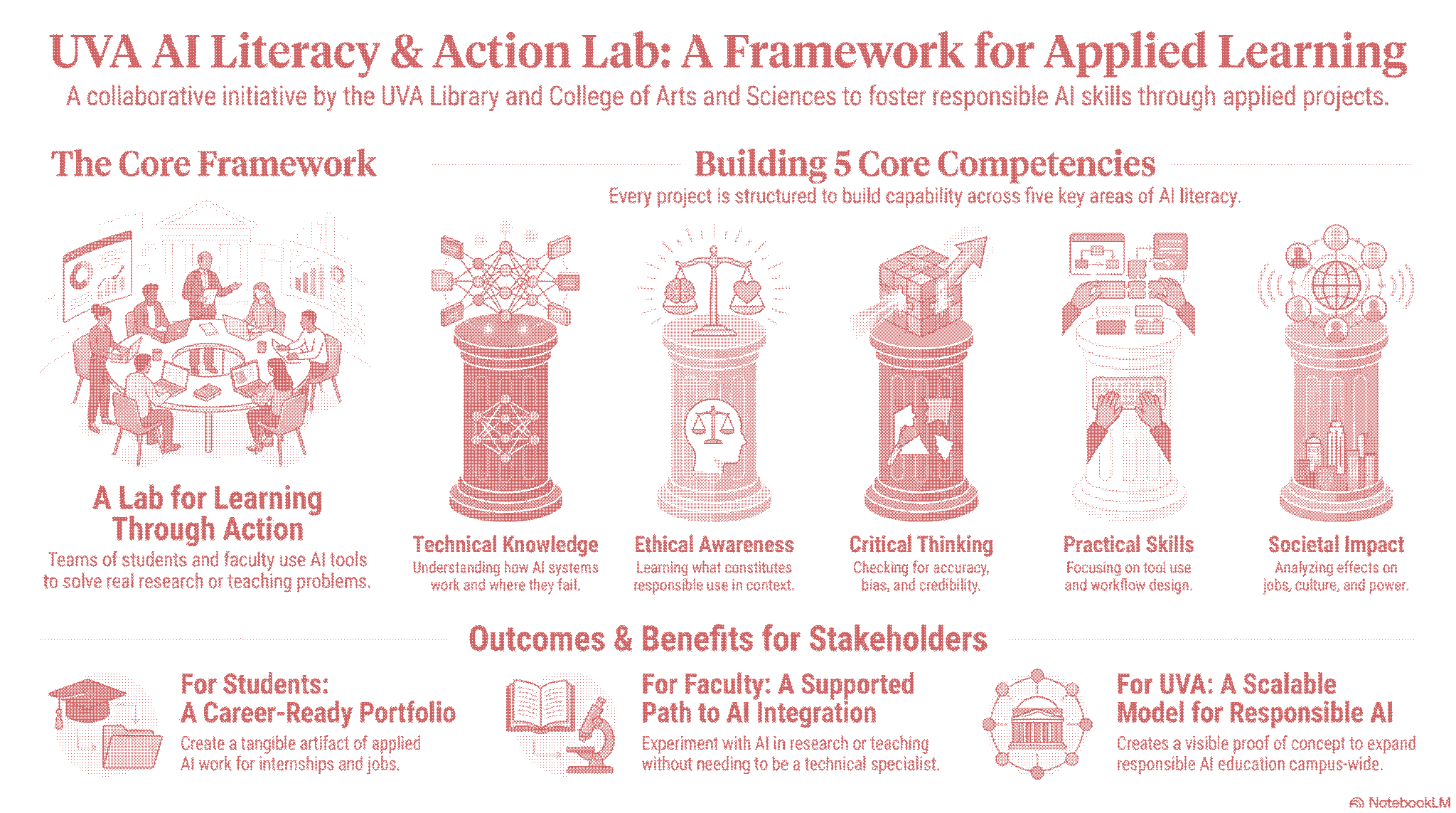
The Universal AI Literacy Framework (Lo, 2025) provides the scaffolding: five components (Technical Knowledge, Ethical Awareness, Critical Thinking, Practical Use, Societal Impact) across four progressive levels (Awareness, Foundational, Applied, Strategic). The WG’s work is to populate this scaffolding with LAM-specific substance – contributed by members from their own institutional experience – and to develop the resources, examples, and good practices the sector needs.
AI Literacy Working Group serves three audiences:
- Practitioners building their own fluency,
- Instructors and educators teaching AI literacy to students and the public, and
- Institutional leaders making policy and resourcing decisions about AI.
Our focus areas follow the Framework’s own stated development agenda: pedagogical strategies for the LAM context; assessment approaches that measure AI literacy at both individual and institutional levels; cultural and global adaptations including translation and regional case studies; and ongoing refinement as AI technologies and the issues they raise continue to evolve. We coordinate with the existing Teaching and Learning WG on areas of shared interest.
The next meeting will be on November 5, 2026 at 16:00 UTC.
The vision of the AI Literacy WG is for AI literacy to become a recognized and scaffolded professional competency across the global LAM sector, supported by shared frameworks, open educational resources, and a sustained peer-learning community that transcends institutional, sectoral, and national boundaries. The WG aims to foster long-term collaboration, knowledge exchange, and the development of practical guidance that will support institutions and professionals in adapting to the evolving role of AI in the LAM field.
Initially, the WG will focus on drafting the LAM Implementation Companion to the Universal AI Literacy Framework, with members contributing institutional experiences, case studies, and good practices across the Framework’s five components. The WG will also publish the Companion and develop instructional and translation pathways that extend its use and impact.
- The LAM Implementation Companion to the Universal AI Literacy Framework (v1.0), published openly with DOI, with contributing members credited by chapter and contribution, designed for institutional adoption.
- A public webinar series spotlighting member implementations, archived openly on the AI4LAM site.
- Instructional and translation pathways extending the Companion, developed with members as adoption progresses.
- Looking further out: a recurring AI Literacy School as a longer-term educational program of the WG.
The Implementation Companion and toolkit will speak directly to situations like these:
- A reference librarian deciding when to use, when to disclose, and when to refuse AI-assisted answers in a research consultation.
- A special collections archivist evaluating an AI training data request from an external partner and weighing provenance implications.
- A museum educator integrating AI literacy into a public program for adult learners.
- A library instructor teaching undergraduates to critically evaluate AI-generated answers in a one-shot session.
- A library or museum director developing institutional policy on staff use of generative AI.
-
Lo, L. S. (2025). AI Literacy for All: A Universal Framework
-
Lo, L. S. (2025). AI literacy: A guide for academic libraries. <em>College & Research Libraries News</em>
-
Lo, L. S. (2026). The CARE approach for academic librarians: From search first to answer first with generative AI. <em>Journal of Academic Librarianship</em>
-
Lo, L. S. (2023). The CLEAR path: A framework for enhancing information literacy through prompt engineering. <em>Journal of Academic Librarianship</em>
-
Ng, D. T. K., et al. (2021). Conceptualizing AI literacy: An exploratory review
-
ACRL AI Competencies for Academic Library Workers


AI literacy is the ability to understand, use, and think critically about AI technologies and their impact on society, ethics, and everyday life. The LAM sector has a particular role to play in building this ability, because our institutions are where communities go to make sense of information, and our staff model what careful engagement with AI looks like.” (Leo S. Lo)