Announcement of the 2026 AI4LAM Innovation Awardees
The AI4LAM Board of Directors is pleased to announce the 2026 AI4LAM Innovation Award recipients. This is the first year the awards are introduced, supported by Schmidt Sciences, marking an important milestone in recognizing responsible, innovative, and community‑driven uses of artificial intelligence across the Libraries, Archives, and Museums sector.
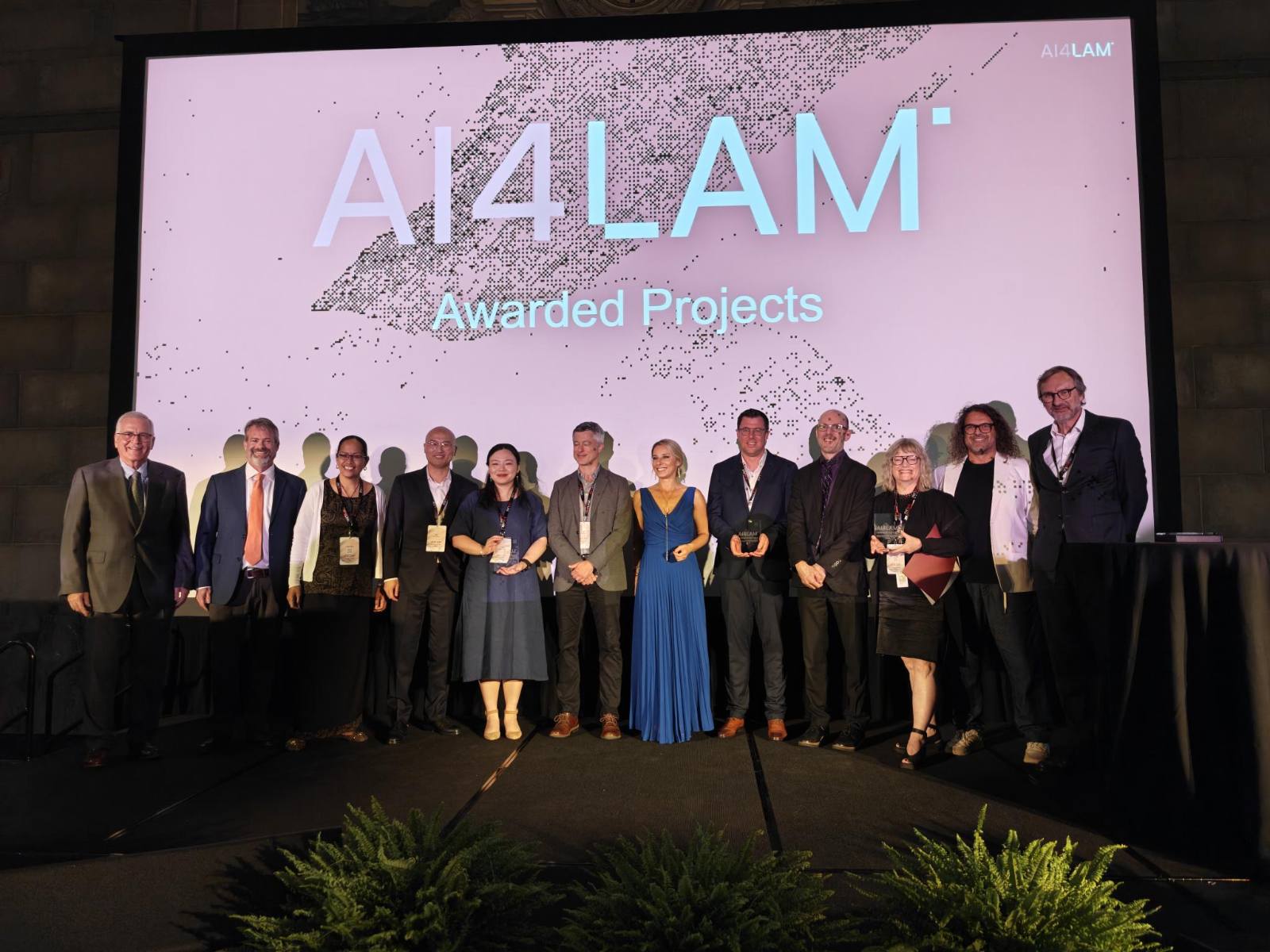
These awards celebrate inspiring, practical, and forward‑thinking uses of artificial intelligence across the Libraries, Archives, and Museums community, highlighting initiatives that advance technological innovation while reflecting the collaborative, open, and responsible values of AI4LAM.
This year’s awards follow an exceptionally rigorous review process. Out of 166 submitted papers, reviewers nominated 12 outstanding projects for consideration. Each of these initiatives demonstrated remarkable quality, creativity, and relevance to the cultural heritage community. The Board, acting as the Awards Committee, faced a genuinely difficult task in selecting the final awardees.
Awardees are recognized across three official categories, with an additional AI4LAM Board Award for exceptional contribution to the cultural heritage AI ecosystem.
Award Categories
- AI4LAM Best Research Project Award
Recognizing experimental, research, or early-stage initiatives with strong potential, relevance, and contribution to the field. - AI4LAM Best Implementation in Practice Award
Recognizing a mature, implemented AI-based system, service, or tool that is actively used in a real-world LAM environment and demonstrates tangible impact. - AI4LAM Best Paper Award
Recognizing an exceptional scholarly paper that advances theory, knowledge and practice in AI for Libraries, Archives, and Museums. - AI4LAM Board Award
Presented by the AI4LAM Board of Directors for exceptional innovation in advancing AI within the cultural heritage sector that exemplifies responsible and meaningful AI innovation in cultural heritage.
The awards are here presented, and we warmly invite all members of the AI4LAM community to explore these remarkable projects. Each of them reflects the creativity, dedication, and collaborative spirit that drive our field forward.
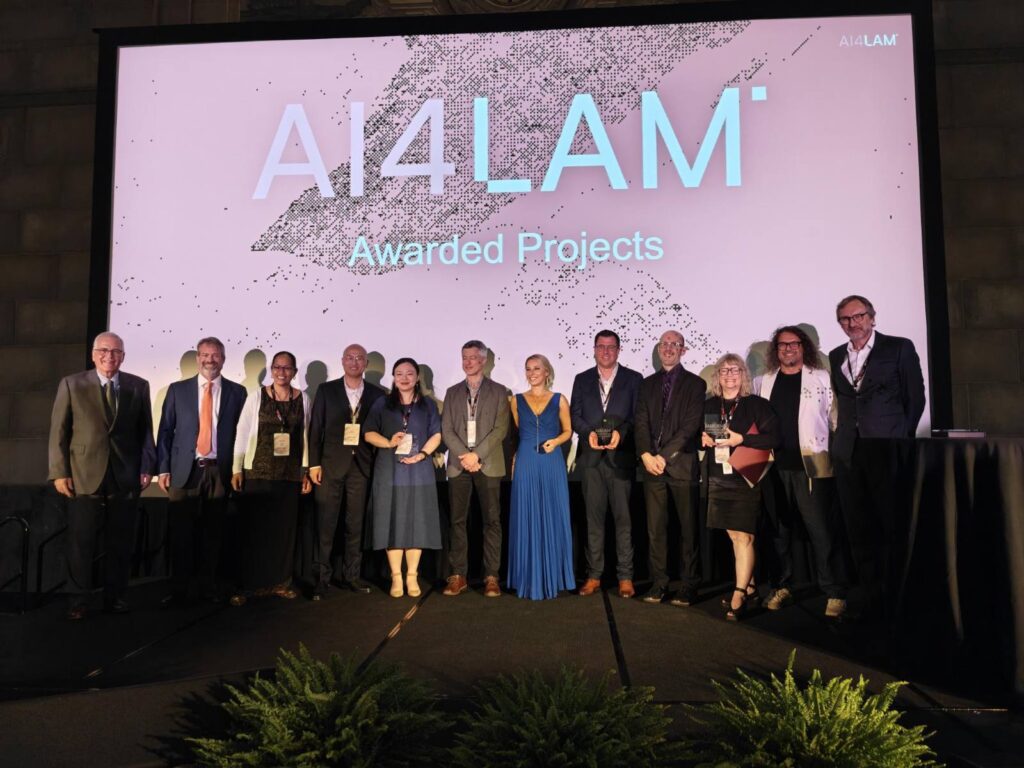
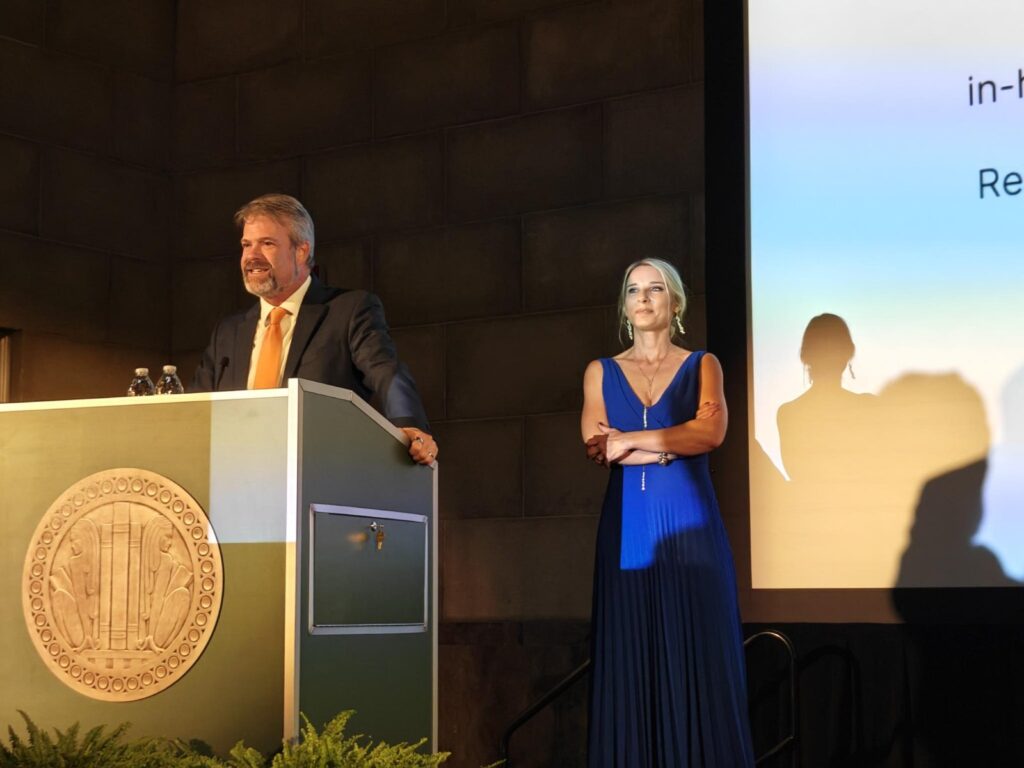
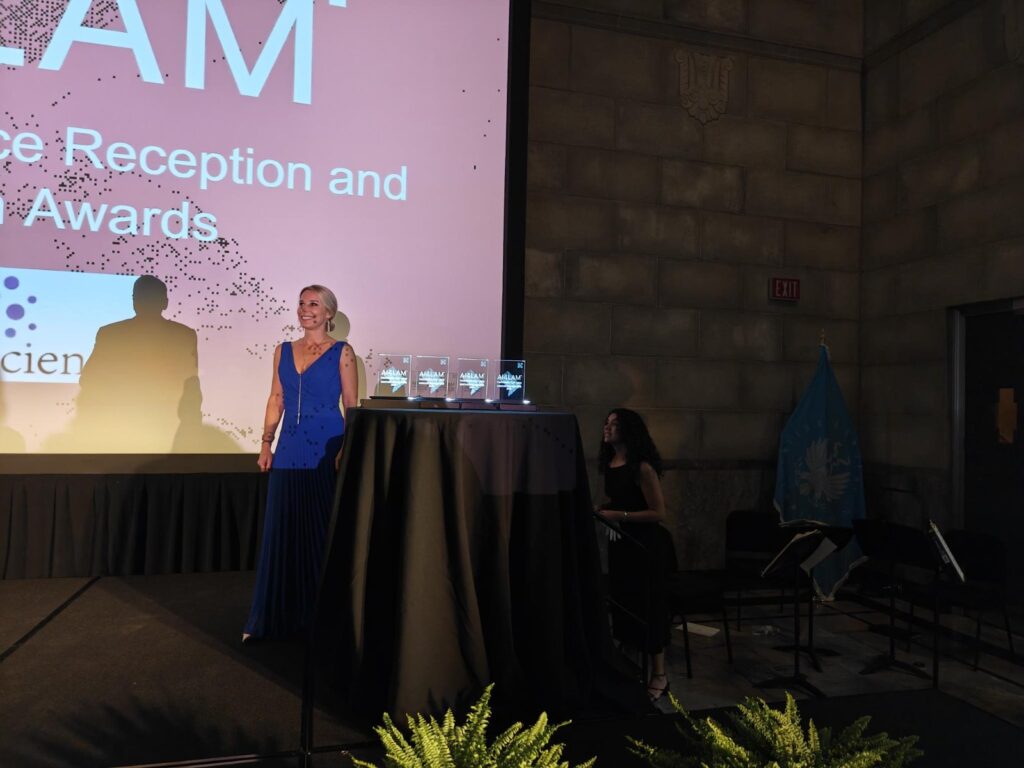
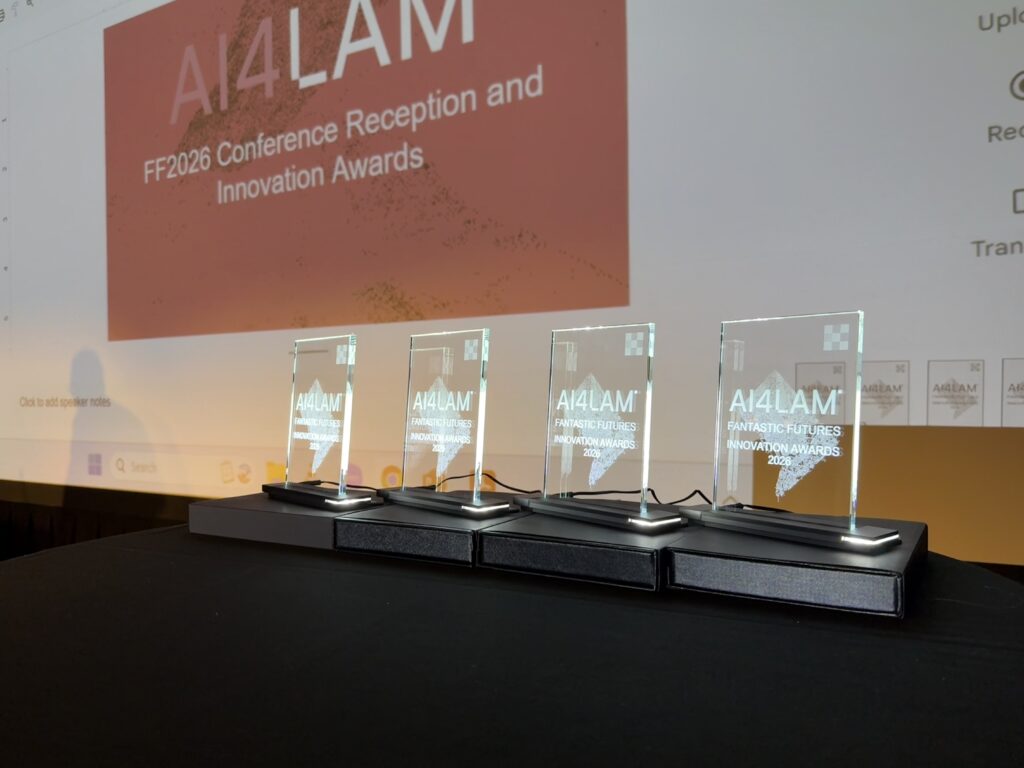
At the ceremony, the AI4LAM Vice President, Michael A. Keller of Stanford, together with Board Member Stuart Snydman of Harvard, proudly presented the four winning Innovation Awards. Heartfelt appreciation was also extended to all twelve nominated projects, whose contributions are highly important and valuable to the advancement of AI in our sector.
1. Best Research Project Award
In the category of Best Research Project, the awarded project is Building AI Tools with Communities on multilingualism and language identification for low-resource languages in public media archives presented by United States of America, Brandeis University; University of Hawaiʻi at Mānoa; GBH Archives; Saint Louis School; and O Le Malamalama Non-Profit Organization.
This award celebrates the meaningfulness of multilingualism by honouring a project that shows how access to heritage languages—especially indigenous and low‑resource ones—can only be achieved through deep human relationships and community‑driven collaboration, reminding us that trust in responsible AI begins with the people whose voices it seeks to amplify.
Building AI Tools with Communities
This presentation describes the human relationships and social infrastructure at the heart of a project to develop open-source spoken language identification tools for a large public broadcasting archive. Public media archives in the United States contain thousands of hours of programming in languages other than English and Spanish, including indigenous and low-resource languages such as Samoan and Yup’ik. These materials are of great value to heritage communities, yet they remain largely undiscoverable because catalog records rarely indicate which languages are spoken. Automatic spoken language identification tools could improve access, but building and evaluating such tools for low-resource languages cannot be done without the people who speak them. Off-the-shelf models are trained predominantly on high-resource languages and perform poorly (if not at all) on the languages most in need of attention. The data required to build or evaluate language identification tools for these languages cannot be sourced from existing corpora; it must be created through collaboration with the communities that speak them.

2. Best Implementation in Practice Award
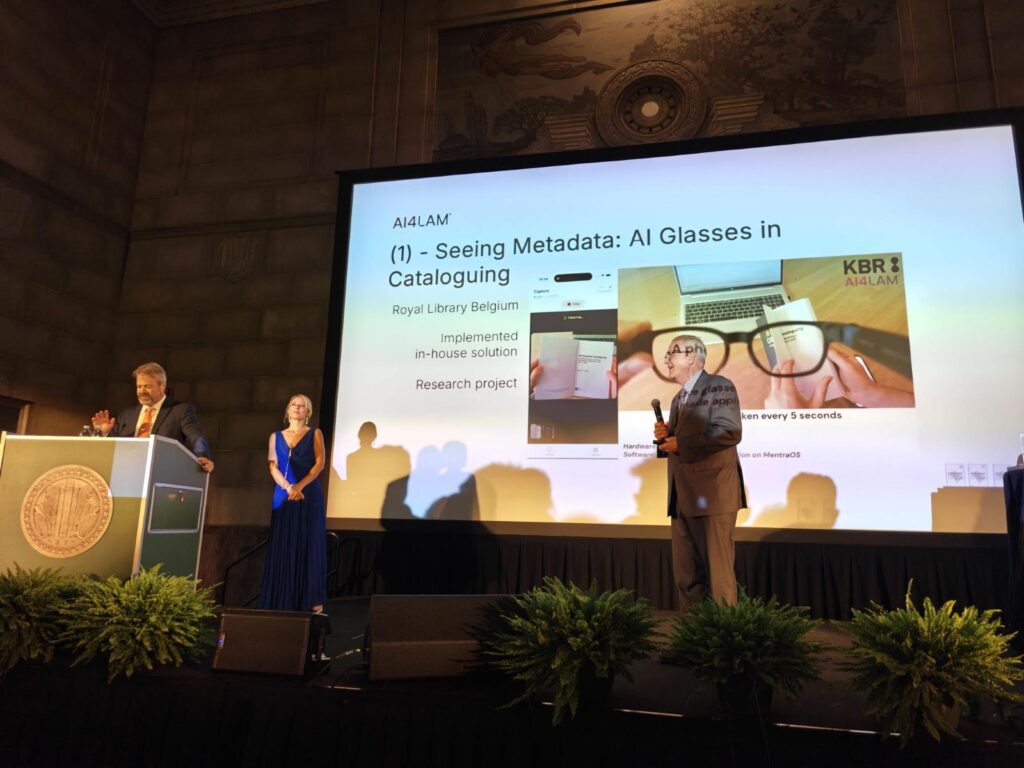
In the category of Best Implementation in Practice, the awarded project is Seeing Metadata: AI Glasses in Cataloguing for Enhancing Trust, Context, and Human Oversight in LAM Workflows, presented by Hannes Lowagie, Royal Library of Belgium.
This award celebrates the meaningfulness of hands‑on AI implementation by recognising a project that demonstrates how real‑time metadata creation can be transformed through practical, on‑the‑ground use of AI‑enabled cataloguing glasses — showing that innovation becomes truly impactful when it is tested, refined, and proven in the everyday physical workflows, supporting work of cataloguers.
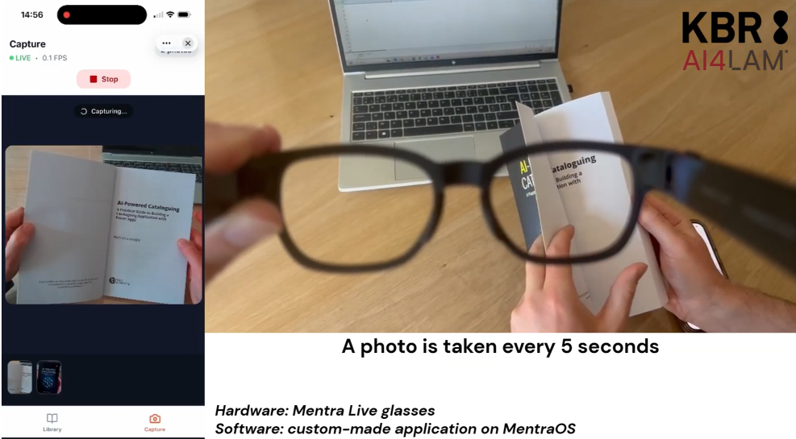
Seeing Metadata: AI Glasses in Cataloguing for Enhancing Trust, Context, and Human Oversight in LAM Workflows
This proposal presents a practical AI implementation in cataloguing: the use of AI-enabled smart glasses to support real-time metadata creation and MARC21 record generation. In this workflow, a cataloguer wearing AI glasses scans a physical book. The system detects the item, extracts bibliographic metadata, and automatically generates a draft MARC21 record, while the cataloguer simultaneously performs essential manual tasks such as barcoding, stamping, and call number labelling.
This approach reframes ‘human-in-the-loop’ as ‘trust-in-the-loop’: the cataloguer remains continuously engaged, validating and correcting AI outputs while maintaining physical and intellectual control over the object. The session explores how such systems can be implemented responsibly in LAM environments, balancing efficiency gains with transparency, accountability, and professional expertise.
3. Best Paper Award
In the category of Best Paper, the awarded project is Nine Months Is an Eternity for assessing a call-to-action Framework for Content Authenticity and Provenance in the Age of AI, presented by Kate Murray form Library of Congress, United States of America, and independent scholar Joshua Sternfeld.
This award celebrates the meaningfulness of thought leadership in our field by recognising a white paper that has mobilised the LAM community around a shared call‑to‑action on content authenticity and provenance, offering both a clear conceptual framework and practical momentum for collective response in an era shaped by artificial intelligence.
Nine Months Is an Eternity for assessing a call-to-action Framework for Content Authenticity and Provenance in the Age of AI
In February 2026, co-authors Kate Murray and Joshua Sternfeld released the open-access report “Content Authenticity and Provenance in the Age of Artificial Intelligence: A Call-to-Action for the LAMs Community.” Working with volunteer contributors from the C2PA and G+LAM Working Group, they recommended a collaborative framework for practitioners and administrators to respond to the challenges artificial intelligence poses for content authenticity and provenance (CAP).
Since its release, the report has received wide and positive response. Murray and Sternfeld presented the call-to-action framework for numerous professional associations, including the Digital Library Federation, Trust in Archives Initiative, and an AI Summit hosted by the University of Wyoming and Wyoming State Library (forthcoming keynote delivered by Sternfeld).
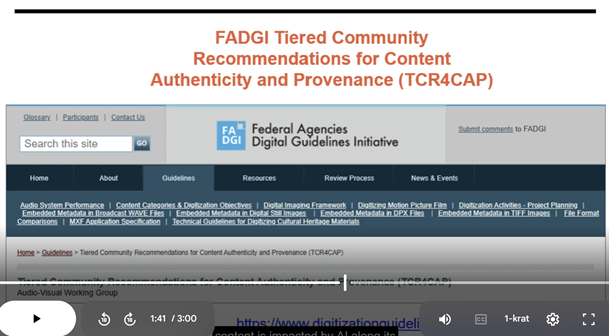
This presentation will serve two purposes by combining a conceptual overview with practical application. In the first part, Murray and Sternfeld will introduce the risks and opportunities associated with AI and CAP, as introduced in the report, followed by an overview of the four pillars and their implications. They will then acknowledge recent activity in the field for each of the report’s four pillars (see below). The presentation will reflect upon the progress the LAM community has taken to advance research, work with various public and private sectors, and respond to the rapid pace of technological development.
4. AI4LAM Board Award
For the AI4LAM Board Award, recognizing exceptional innovation, the awarded project is AI4Culture as a Model for Reuse, Transparency, and Institutional Capacity for shared AI infrastructure for cultural heritage presented by Marco Rendina from European Fashion Heritage Association, Italy.
This award celebrates the meaningfulness of shared AI infrastructure by recognising a project that demonstrates how cultural heritage institutions can move beyond fragmented pilots toward a common, openly documented ecosystem of tools, datasets, and reusable workflows — showing that AI becomes truly operational, transferable, and accountable only when it is built as collective infrastructure that lowers barriers and empowers those without extensive in‑house expertise.
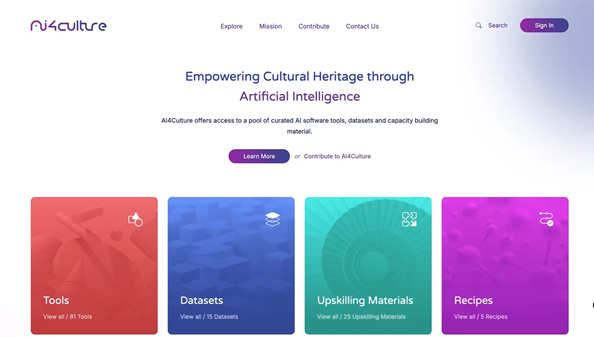
AI4Culture as a Model for Reuse, Transparency, and Institutional Capacity for shared AI infrastructure for cultural heritage
AI4Culture offers a shared AI infrastructure, developed within the common European data space for cultural heritage. It positions AI not as a standalone technical layer but as a shared infrastructure composed of tools, datasets, upskilling resources, and reusable workflows. The tool registry combines components customised specifically for cultural heritage tasks, such as multilingual HTR, subtitle generation, semantic enrichment, machine translation of metadata, with more than fifty third-party tools documented for sector use. The dataset section gathers curated, openly licensed collections suitable for training, fine-tuning, and benchmarking. This shared infrastructure matters because the current AI landscape for cultural heritage remains fragmented. Institutions often face a scattered mix of pilots, specialist tools, and closed commercial services that are difficult to evaluate, integrate, or sustain.
By bringing together openly documented tools, datasets for training, testing, and evaluation, and reusable workflows for real cultural heritage tasks, it lowers the threshold for adoption while also strengthening transparency and interoperability. Its value lies not only in what individual tools can do, but in how they can be discovered, combined, and adapted to cultural heritage needs. This is particularly important for researchers, heritage professionals, and institutions working without extensive in-house AI expertise. Infrastructure, in this sense, is not just a technical backend. It is what makes AI operational, transferable, and accountable in practice.
Congratulations to all awarded projects!
Your work inspires our community and strengthens the future of AI in cultural heritage. We hope that these contributions will encourage you to submit your proposals next year and continue sharing your ideas and inspiring work with our community.
We also encourage our community to consider submitting their own inspiring work for next year’s AI4LAM FF2027 awards — your ideas and initiatives shape the future of AI in cultural heritage.
Individually we are slow and isolated; collectively we can go faster and farther.