
Working Groups
AI4LAM wants to stimulate broad activity within the area of AI in GLAM. One platform for such activity is working groups, where stakeholders from different institutions with common interests can come together and work collaboratively.
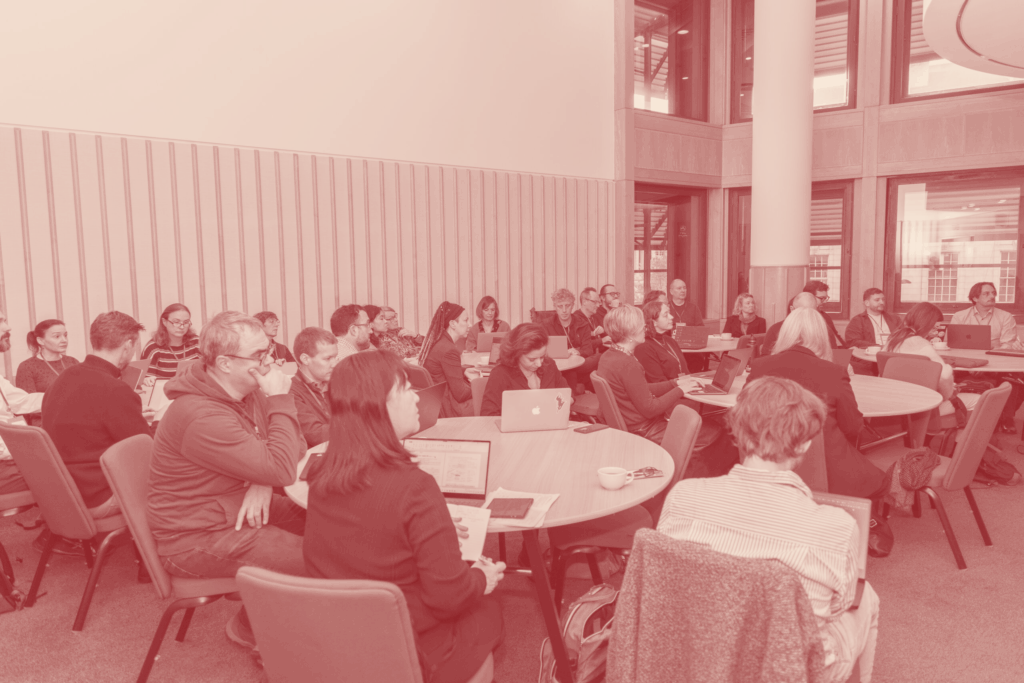
Working Group (WG) is a group of professionals from at least 3 different LAM institutions collaborating on a field of interest. Anybody with the needed skills and competence as well as willingness to contribute in the groups work should be accepted as members. Individuals from the commercial sector outside LAMs may be members of working groups on an individual level.
WGs are established to carry out specific, program activities that advance, develop, and support AI4LAM’s strategic working areas and directions. The subject for the WG must be relevant for AI4LAM.
Any Member Organization or individual professional actively engaged in the AI4LAM community work and activities can propose formation of a new WG.
Operational Working Groups
The Metadata Working Group explores and shares the ways in which AI technologies can be applied to the creation and enhancement of metadata for cultural heritage resources. It will also address the role of metadata in collecting, curating, and describing the resources needed for AI, machine learning, and data science more broadly.
Read more
The Teaching and Learning Working Group (T&LWG) was formed in August 2020. We see it as fundamental that knowledge-building reaches all members and stakeholders across the GLAM sector and related organizations that may be impacted by AI technologies. We aspire to create a space for practitioners to exchange knowledge, foster community building, seed collaborations and to generate much needed discussions around the implementation of AI in GLAMs.
Read more
The AI evaluation working group champions a systematic process to develop evaluation rubrics and publicly-available copyright-cleared datasets for determining the suitability of AI models and tools for LAM-specific operations. It will also conduct an initial set of evaluations of selected models and tools.
Read more
We share needs and approaches, facilitate the dissemination of practical workflows and production pipelines, foster collaborations, and set the stage for potential sharing of data, models, and/or software in this area. The group will also monitor the changing landscape of ASR technologies and explore the implications for the LAM community.
Read more
dedicated space for ai4lam members to develop and exchange knowledge around the implementation of Automatic Text Recognition (ATR), both for OCR (Optical Character Recognition) and HTR (Handwritten Text Recognition). It aims to foster greater collaboration between ai4lam members keen to share needs, approaches and challenges in implementing ATR workflows, as well as successful use cases, data, models and/or tools.
Read more
Emerging Working Groups
The following Working Groups are currently in the process of being established. Member organizations are encouraged to follow AI4LAM updates to learn how they can participate and contribute once the group becomes active.
As cultural heritage institutions increasingly rely on AI-driven systems for access, preservation, and digital transformation, this WG provides a collaborative space to address the unique cybersecurity challenges that arise in libraries, archives, and museums.
Purpose is to advance the use of AI techniques for analysing, describing, and connecting visual materials in GLAM collections, as well as support institutions in applying computer vision and related technologies in ways that respect cultural context, ethical considerations, and collection stewardship values.
It focuses on advancing the use of AI to interpret, manage, and enhance access to three‑dimensional cultural heritage collections. As GLAM institutions increasingly create and steward 3D models—from archaeological artifacts and natural history specimens to architectural scans and immersive environments—this WG provides a collaborative space to explore how AI can support the preservation, understanding, and discovery of complex digital objects.
Purpose is to build shared understanding of what AI literacy means for libraries, archives, and museums, and equip GLAM professionals with the knowledge and confidence to engage critically and creatively with AI technologies.
The WG explores how robust digital infrastructures, intelligent agents, and interoperable data ecosystems can support AI innovation across the GLAM sector. Purpose is to promote interoperable, secure, and sustainable infrastructures that support data‑driven research, AI agents, and cross‑institutional collaboration, and to strengthen the technical and organizational foundations needed for AI adoption in libraries, archives, and museums.
It investigates how conversational AI, intelligent assistants, and exploratory interfaces can enhance access to cultural heritage collections. As GLAM institutions experiment with chat‑based discovery tools, virtual guides, and AI‑driven research assistants, this WG provides a collaborative space to explore how these technologies can support users in navigating, understanding, and engaging with collections in more intuitive and meaningful ways.
It focuses on how AI can support the large‑scale collection, preservation, and accessibility of born‑digital materials acquired through legal deposit and web archiving programs. Explores how AI can improve reuse, processing, and access to born‑digital and harvested content.
For additional information consult AI4LAM Statutes or contact our office at:
secretary-general@ai4lam.org.