Historic Records Limited joins AI4LAM and shares insights on AI transcription at scale
We are delighted to announce that British company, Historic Records Limited has joined AI4LAM as a new Member Organisation. Based in the United Kingdom, Historic Records brings more than 30 years of experience working with archives, museums, and the private sector, providing digitisation, transcription, and access to archival collections. The organisation has extensive expertise in applying AI to the transcription of historical documents and the extraction of structured data from unstructured archival content.
To mark its membership, Historic Records has contributed the article below, entitled AI Transcription at Scale, exploring how AI-enabled workflows can support large-scale transcription projects within the GLAM sector. The article outlines Historic Records’ approach to combining Optical Character Recognition (OCR), Handwritten Text Recognition (HTR), Natural Language Processing (NLP), and expert human validation to transform handwritten and printed historical records into high-quality, searchable data. Drawing on decades of experience, the article highlights both the opportunities and practical considerations involved in delivering accurate and scalable AI-assisted transcription for cultural heritage collections.
We are pleased to share Historic Records’ insights with the AI4LAM community and look forward to future collaboration and knowledge exchange.
AI Transcription at scale
Successful AI transcription projects depend on far more than the technology itself. Preparation, planning, validation and human expertise are essential to turning millions of records into reliable, searchable information.
The illusion of simplicity
There is a growing perception that advances in artificial intelligence have made large-scale transcription a relatively straightforward exercise. Feed a collection of scanned documents into an AI model, allow the technology to process them, and retrieve an accurate digital transcription at the other end.
For modern, well-structured documents where the layout of the text is always consistent this may be a reasonable approximation of what happens. For large-scale archival transcription projects involving handwritten text, complex printed material and inconsistent document formats, it overlooks the real challenge.
The difficulty is not simply getting an AI model to read a document. It is ensuring that the resulting information is accurate, consistent, complete, meaningful and suitable for its intended purpose.
At Historic Records Limited, we believe that successful AI transcription depends on understanding a fundamental principle: the AI component is only one part of a much larger process. The preparation that precedes it and the validation, refinement and structuring that follow are every bit as important as the technology itself.
Without these surrounding processes, even the most sophisticated AI model can produce results that look convincing but fail to deliver the quality and reliability that a professional transcription project demands.
Establishing the foundations
The first phase of a successful project begins well before any documents are submitted for transcription. It involves understanding the collection, defining the desired outcomes and establishing the conditions under which the technology can deliver them.
1. Understanding the source material
No two collections are identical. A neatly printed directory presents different challenges from a handwritten register, a bound volume with tightly packed columns, or a collection of documents spanning several centuries.
Legibility, image quality, document structure, historical terminology, handwriting styles and variations in layout can all influence the most appropriate approach.
An initial assessment should establish what the collection contains, how consistently it is organised, what information it holds and which characteristics might create difficulties for automated recognition.
Where documents have already been digitised, their suitability for processing must also be assessed. Existing digital images may be perfectly adequate, but others may require additional image processing or, in some cases, digitisation again.
The objective is to understand the material before deciding how best to process it.
2. Defining success
Transcription is rarely an end in itself. The ultimate objective is usually to make information accessible, searchable and useful.
A project may require a complete transcription of every word on a page. Alternatively, it may need to extract specific fields — names, dates, occupations, addresses, events or other key information — from thousands or millions of records. These are different tasks, with different technical requirements and different measures of success.
Before processing begins, the project team must establish precisely what information is required, how it should be represented, which transcription conventions should apply and how exceptions or uncertainty should be handled.
For example, should historical spelling be preserved or modernised? Should abbreviations be expanded? How should illegible text, corrections, marginal notes and missing information be recorded? What happens when a date is ambiguous or a name could reasonably be interpreted in two ways?
These decisions may appear minor when considered individually. Across a project involving millions of records, however, inconsistent decisions can undermine the value of the entire dataset. Clear specifications, agreed rules and representative samples provide the foundation for consistent output.
3. Testing the technology
AI is not a single, universal solution. Different models and techniques can produce quite different results depending on the material being processed and the information being extracted.
A model that performs well on clean printed text may struggle with historical handwriting. A more powerful model may even prove less suitable for a particular task if it attempts to interpret, normalise or infer information that should instead be reproduced faithfully.
Consequently, technology selection should follow assessment and testing, rather than the assumption that the newest or most sophisticated model will automatically deliver the best outcome.
At Historic Records, we assess the suitability of AI on a project-by-project basis and test alternative models where appropriate. The purpose is to establish a workable balance between accuracy, consistency, processing efficiency and cost.
Representative samples are particularly important. They allow the proposed approach to be evaluated against real source material, with findings used to refine the process before it is applied at scale.
The objective is not simply to demonstrate that AI can transcribe the collection. It is to establish how reliably it can do so, under what conditions, and with what safeguards.
Managing the process
Once the foundations have been established, the AI processing phase can begin. However this is not simply a matter of submitting images and waiting for results.
Large collections frequently contain variations and exceptions that cannot be anticipated fully at the outset. Image quality may fluctuate, layouts may change between volumes, and previously unseen document types may emerge as processing progresses.
A robust production pipeline must therefore accommodate these variations, monitor performance and identify records that require additional attention.
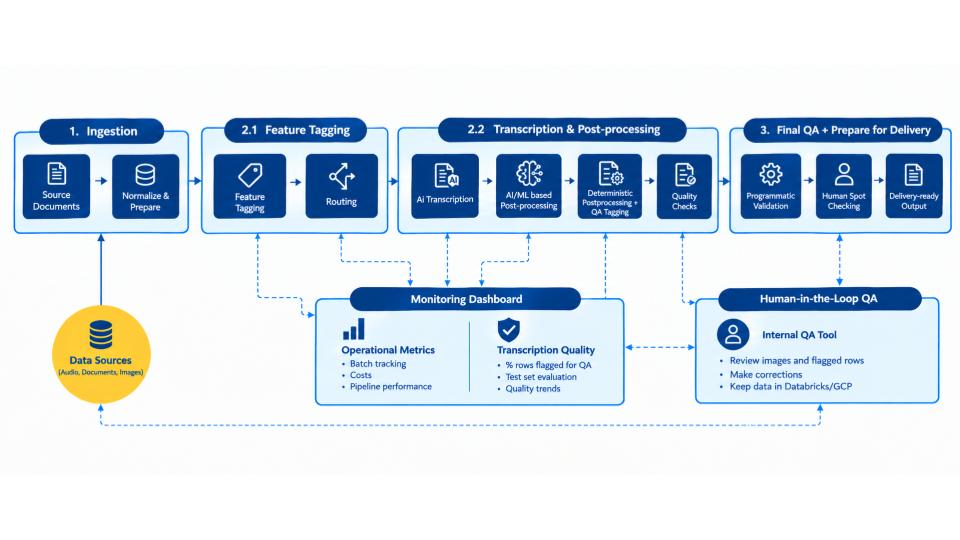
Pre-processing may be needed to improve images or make their structure easier for recognition systems to interpret. Optical Character Recognition (OCR) and Handwritten Text Recognition (HTR) can then be used, as appropriate, to recognise printed and handwritten content. Natural Language Processing (NLP) and other extraction techniques may subsequently help identify, classify and organise the required information.
These stages must work together as a coordinated process, rather than as disconnected technical operations.
For structured data extraction, the challenge is still greater. Recognising the words on a page is only the beginning. The system must also determine which words belong to which fields, associate information correctly with individual records and preserve the relationships that make the data meaningful.
A name detached from its corresponding address, an occupation assigned to the wrong individual, or a date placed in the wrong field may leave a record looking complete but it is worse than inaccurate – it is misleading, sending the user down the wrong path from the outset.
The processing pipeline must therefore be designed around the intended output, not merely the transcription of the source image.
Quality assurance
Perhaps the most important misconception about AI transcription is that the production of an output marks the completion of the work. In reality, AI output should be treated as the beginning of a further phase of processing, verification and quality assurance.
AI systems can misread characters, omit information, confuse adjacent entries, misinterpret unusual layouts and produce plausible-looking answers where the source material is ambiguous. The danger is that these errors may not be obvious. A result can appear perfectly credible while being factually wrong.
This is particularly important when working with historical records, where names, places, occupations and terminology may be unfamiliar to contemporary systems.
1. Automated validation
AI output should never simply be accepted without scrutiny.
Automated post-processing checks can identify inconsistencies, malformed records, missing fields, unexpected values and other departures from the agreed specification. Where appropriate, validation can also draw on existing finding aids, authority files, dictionaries and reference data to identify potential errors.
These checks help establish consistency across large volumes of output and allow exceptions to be identified systematically.
However, validation rules must be designed carefully. Historical records frequently contain unusual but legitimate information, and a system that rejects everything on the basis that it is unexpected risks introducing a different kind of error.
Automated validation is therefore most effective when it combines clearly defined rules with an understanding of the source material.
2. Human expertise and judgement
Automation can perform substantial amounts of repetitive work, but it does not remove the need for human expertise.
Experienced reviewers can assess ambiguous readings, identify implausible interpretations, distinguish genuine historical variations from recognition errors and make judgements that cannot always be reduced to a simple rule.
Human review also provides a means of identifying recurring problems. If a particular document format consistently produces errors, the answer may not be to correct each record individually. It may be to improve the image processing, adjust the recognition approach or refine the extraction rules.
At Historic Records, our approach combines purpose-built processing pipelines, proprietary automated validation and human-in-the-loop review. Our expert team provides final oversight so that output is not delivered to clients without human sign-off.
The aim is not to replace human expertise with AI, but to use AI to undertake the heavy lifting while applying specialist knowledge where it makes the greatest difference.
3. Structured output
The value of a transcription project is ultimately determined by what can be done with its results.
For many organisations, a collection of transcribed text files is not enough. They need structured records that can be searched, filtered, linked and incorporated into existing systems or published through online platforms.
This requires additional work after text recognition: parsing information into the correct fields, standardising data where agreed, preserving links to source documents, resolving relationships between records and preparing the output for database ingestion.
The distinction is significant. A scanned archive is a visual resource. A transcribed archive is a textual resource. A carefully validated and structured archive becomes a dataset that can support discovery, research, analysis and new ways of accessing information.
That transformation is where much of the long-term value lies.
Continuous improvement
No matter how carefully a project is planned, some exceptions will only become apparent during production.
A new handwriting style, an unfamiliar abbreviation or a previously unseen layout may reveal a weakness in the existing process. These discoveries should not simply be dealt with as isolated problems. Instead, they should feed back into the production pipeline.
Corrections can inform revised rules, improved validation checks, adjusted models and more effective handling of similar material in subsequent batches. Performance should be monitored throughout the project, with quality metrics used to identify trends and assess whether changes are delivering the intended improvements.
This creates a cycle of continuous improvement in which human expertise helps refine automation, while automation allows that expertise to be applied more efficiently across increasingly large collections.
Importantly, this process requires active management. Continuous improvement does not happen simply because a project uses AI. It depends on collecting evidence, investigating exceptions, learning from mistakes and implementing changes in a controlled manner.
Security, governance and accountability
Large-scale transcription projects may involve sensitive, commercially valuable or otherwise restricted information. Security and governance must therefore be considered alongside accuracy and throughput.
Organisations need to understand where their data is processed, which systems and service providers can access it, what controls govern that access, and how processing activity is monitored and audited.
They must also establish clear arrangements for handling, retaining and delivering both source material and derived data.
At Historic Records, our approach includes centralised data governance, fine-grained access controls and auditing through our enterprise infrastructure. Our architecture is also designed to retain control over model routing and external model access.
These considerations are not peripheral technical details. They are part of the preparation required to ensure that a transcription project is suitable for the organisation commissioning it and that its outputs can be managed responsibly.
The balance between these measures will vary from project to project. What matters is that success is defined at the outset and assessed throughout the process, rather than judged solely by the volume of AI output produced.
A complete process
The potential of AI transcription is considerable. It can make previously inaccessible collections economically viable to process, accelerate the extraction of information and help organisations unlock value from material that might otherwise remain difficult to search or analyse.
But these benefits do not arise from the technology alone. They depend on understanding the source material, defining the required outcomes, selecting and testing the right tools, preparing the documents, designing an appropriate production pipeline, validating the results, applying human judgement and converting the output into a usable resource.
These activities are not optional additions to an AI project. They are integral to its success.
At Historic Records Limited, we bring together digitisation, AI-enabled transcription, structured data extraction and human expertise to help organisations transform complex historical documents into accessible, searchable information. We have transcribed and licensed more than 200 million records, and our experience reinforces the importance of choosing the right approach for each collection rather than assuming that a single technology will solve every problem.
Our philosophy is straightforward: use AI where it delivers genuine benefits, retain human expertise where it matters, and build the processes around both to ensure quality at scale.
The most successful AI transcription projects are not those that simply deploy AI. They are those that prepare for it properly, manage it intelligently and take responsibility for what happens after it has finished.
When the objective is to create reliable information from millions of historical records, AI is only part of the story. The work that surrounds it makes all the difference.